

London Biggin Hill Airport is committed to being a good neighbour to it’s local community. However, if you live near an airport it is inevitable you will hear and see aircraft – these aircraft are required to adhere to procedures and air traffic instructions whilst operating in and out of London Biggin Hill.
Our online flight tracker, WebTrak, uses the radar service from National Air Traffic Services (NATS) at Heathrow Airport and allows the system to automatically file a violation report, should aircraft depart from the agreed flightpaths when arriving or departing the airport. The violation reports are then investigated by London Biggin Hill Airport (LBHA) in the same way that we investigate complaints relating to specific aircraft movements.
You can report an aircraft that you think is not complying with the agreed noise abatement protocols. To help you through this process, we have put together some guidance on how to use WebTrak and how aircraft operate at LBHA.
Give Us Your Feedback
How can a complaint be made?
The easiest way to register a complaint about an aircraft movement is by using the WebTrak system. This has a simple form designed to ensure we have all of the required information to process your complaint effectively, including data gathered about the specific aircraft movement. Filling in this form comprehensively will enable us to investigate your feedback in full.
To submit a complaint that is not related to a specific aircraft movement, please use our online general complaints form which can be found here: Make a Complaint
A telephone message line, 01959 578580, can also be used to register a complaint that does not relate to a specific aircraft movement. Please include details on how we can contact you with a response or for further information to enable us to investigate your complaint fully.
Complaints received more than 7 days after the event took place will not receive a response.
We aim to respond within the following timeframes:
- On receipt of the complaint using WebTrak within 1 working day.
- To respond to a complaint submitted using the online form, email or telephone within 4 working days.
- To confirm the outcome of the initial investigation within 10 working days.
- To confirm the outcome of a review by the Safety and Noise Abatement Review Board (SANARB) within 40 working days.
How do we process complaints?
All complaints received are investigated to assess compliance or non-compliance with the noise abatement measures set out in the airport’s Noise Action Plan (NAP).
The investigation and response process is outlined below:
- Stage 1: Complaint Received and Acknowledged
The complaint is logged and acknowledged. The airport aims to issue a response for those complaints submitted via WebTrak within 1 working day and 4 working days for complaints submitted by all other means.
- Stage 2: Initial Investigation
An initial assessment is carried out to determine potential compliance or non-compliance with noise abatement measures.
- Stage 3: Compliance Response or Further Investigation
The complainant is advised whether the aircraft movement was compliant or whether further investigation is required. The airport aims to issue Stage 3 responses within 10 working days.
- Stage 4: Further Investigation
A detailed investigation is undertaken where initial findings indicate a potential breach.
- Stage 5: Safety and Noise Abatement Review Board (SANARB) Outcome
Findings are reviewed by SANARB, including any additional information provided by pilots or operators. The airport aims to issue Stage 5 responses within 40 working days, allowing sufficient time for full investigation of all aspects of the potential non-compliance. If the operator of an aircraft fails to respond to our request for an account of their actions, a temporary ban for the operator will be applied until a response is received.
The process can also be viewed as a flow chart here.
Complainants will receive written updates at Stage 1 and Stage 3 for all complaints submitted. A further written response will be provided at Stage 5 for complaints that are confirmed as breaches of noise abatement measures.
All personal information relating to complainants is redacted before cases are referred to SANARB and the Noise and Safety Subcommittee (NSSC). Records of all complaints are retained for a period of 5 years and are included in a redacted format for the NSSC report presented to the quarterly Airport Consultative Committee (ACC).
What are autoviolations?
London Biggin Hill Airport’s (LBHA) noise and track keeping system is capable of automatically identifying breaches of the published noise abatement procedures relating to Noise Sensitive Areas (NSAs) and Track Violation Limits (TVLs).
When an aircraft enters an NSA or flies outside a defined TVL, an autoviolation is generated. This is reviewed and investigated by the Noise Team in the same way as any complaint submitted by a member of the public. Where a complaint corresponds to an aircraft movement that also triggered an autoviolation the system links the two, and the autoviolation is recorded alongside the complaint.
If the investigation confirms that a breach of the noise abatement measures has occurred, a full review is undertaken. This follows the usual complaint process.
Safety and Noise Abatement Review Board
The Safety and Noise Abatement Review Board (SANARB) meets monthly and is made up of an Independent Chair, pilots qualified in a variety of aircraft types, the airport’s Chief Executive Officer (CEO), Head of Safety & Compliance, Head of Sustainability and the London Borough of Bromley Airport Monitoring Officer (AMO). The Board will review all recommendations for warnings, fines and bans from operating at London Biggin Hill Airport (LBHA) made by the Independent Chair and CEO.
Noise and Safety Subcommittee
The Noise & Safety Subcommittee (NSSC) is a formal subgroup of the Airport Consultative Committee (ACC), established in 2016 following the approval of extended airport operating hours. Its primary purpose is to review how all noise and safety related complaints are processed, assess the outcomes, and examine the information provided to complainants to ensure transparency and accountability.
Purpose of the Committee
- To review all complaints submitted relating to noise and safety.
- To examine how complaints are processed and resolved.
- To evaluate the quality and completeness of responses issued to complainants.
- To provide oversight and assurance to the main ACC.
Meetings & Governance
- The committee meets quarterly.
- Findings and recommendations are formally reported back to the ACC.
- The Chair of the ACC, in consultation with Biggin Hill Airport Ltd (BHAL), appoints the Chair of the NSSC.
-
Committee Membership
The membership consists of representatives from key operational, regulatory, and technical bodies:
- London Borough of Bromley – Airport Monitoring Officer (AMO)
- BHAL Chief Executive Officer (CEO)
- BHAL Head of Sustainability
- BHAL Head of Air Traffic Services
- BHAL Head of Safety & Compliance
- Bickerdyke & Allen – independent noise consultants
-
Role of the Airport Consultative Committee
All airports are required by the Department for Transport (DfT) to communicate openly and effectively with their local communities and users of the airport about the impact of the airports operations. This is the role of the Airport Consultative Committee (ACC) – government guidelines have been created to assist with establishing and running an airport’s ACC.
Minutes of all ACC meetings held at London Biggin Hill Airport (LBHA) are published here.
The ACC has a Noise and Safety Subcommittee (NSSC) that reviews all complaints that are brought before the Safety and Noise Abatement Review Board (SANARB). The Chair of NSSC will report the findings to the ACC at the quarterly meetings.
The London Borough of Bromley Airport Monitoring Officer (AMO)
The role of the London Borough of Bromley’s Airport Monitoring Officer (AMO) is to have oversight of the airport’s adherence to the noise abatement measures and compliance with the Noise Action Plan (NAP). The AMO has access to the noise and track keeping system that records all aircraft movements, noise events and submitted complaints.
The AMO also sits as an observer on the Noise and Safety Subcommittee (NSSC), Airport Consultative Committee (ACC) and the Safety and Noise Abatement Review Board (SANARB), which has oversight of compliance to the NAP. The AMO also has the ability to represent a complainant to validate the outcome of any complaint.
Mobile Noise Monitors
In addition to the two fixed noise monitors at either end of our runway, we have two mobile noise monitors that are available to be positioned in residents’ properties to measure the noise generated by aircraft.
Applications can be made for the monitor to be positioned in your garden for up to two weeks. The monitor will appear on the WebTrak system so that you and other WebTrak users can see the noise levels in decibels. At the conclusion of the monitor being deployed a noise report will be sent to the resident containing all noise occurrences. If you would like to apply, please email: [email protected]
The monitors are calibrated annually by a noise specialist in accordance with the conditions of the Noise Action Plan (NAP).
Vexatious Complaints
London Biggin Hill Airport (LBHA) has a dedicated policy that sets out how noise complaints that are persistent, excessive, or are submitted by an individual without reasonable grounds, particularly when such complaints concern legitimate aircraft operations that are unlikely to be resolved, are managed. These fall under the category of vexatious complaints.
The airport remains committed to responding to all complaints in a timely, fair, and transparent manner. The Vexatious Complaints Policy ensures that the complaints system is protected from misuse while safeguarding the rights of all individuals to raise legitimate concerns.
The full Vexatious Complaints Policy can be accessed here.
Noise Sensitive Areas (NSAs)

At what height are aircraft permitted to overfly a Noise Sensitive Area?
A Noise Sensitive Area (NSA) has a ceiling of 2,000’ Above Mean Sea Level (AMSL).
WebTrak displays the altitude of all aircraft in relation to the height of the centre of London Biggin Hill Airport’s (LBHA) runway, which is 599’ AMSL.
Therefore, an aircraft displaying on WebTrak as 1,401’ (2,000’-599’) is flying above the NSA ceiling and could overfly an NSA at that altitude in full accordance with the noise abatement measures.
How is the height of an aircraft measured?
The height of an aircraft is measured in two ways, Above Ground level (AGL) and Above Mean Sea Level (AMSL).
AGL gives the true height above the surface and is crucial for safety because it tells pilots how much actual airspace separates the aircraft from the terrain or obstacles directly below.
AMSL is altitude measured from average sea level, rather than the ground beneath the aircraft. It is used by pilots for flight and navigation purposes. Altimeters normally measure height in AMSL using the local air pressure on the runway.
Why this matters for residents
- When the airport communicates with local residents, AGL is used because it reflects the actual height above homes, fields, and villages.
- AMSL is useful for pilots and Air Traffic Control (ATC) but is less meaningful when describing how high an aircraft is over a community.
For what reason may Air Traffic Control instruct a pilot to enter a Noise Sensitive Area?
Safety is the primary reason for instructing a pilot to enter a Noise Sensitive Area (NSA). This may be to deconflict with aircraft taking off or landing, or to maintain safe separation to avoid wake turbulence.
Wake turbulence separation is the minimum spacing between aircraft to prevent hazardous encounters with the vortices generated by preceding aircraft.
Other reasons where a pilot might also request direct routing through an NSA include, but are not limited to, reasons of safety of the aircraft by way of a mechanical fault or medical reasons.
What are Track Violation Limits (TVLs)?
Business aviation aircraft, primarily jets and turbo prop aircraft, are required, when departing under Instrument Flight Rule (IFR) conditions from London Biggin Hill Airport (LBHA), to follow a Noise Preferential Route (NPR). The NPR is the ideal route to be flown when departing from either Runway 21 to the north or Runway 03 to the south.
With the varying performance levels of the different aircraft types that use LBHA, and different flying conditions, following the precise NPR is not always possible. A cone is created around the NPR, named a Track Violation Limit (TVL). This dictates area of movement from the NPR that is deemed acceptable. Aircraft that exceed the TVL boundaries on departure trigger an autoviolation.
The Civil Aviation Authority (CAA) deems an aircraft to be on track if it remains within 1.5 nautical miles either side of a flight path. TVLs at LBHA are established under this premise.

In addition to remaining within the TVL, aircraft are required to maintain a speed no higher than 185 knots. This is designed to keep noise levels to a minimum.
The image below shows both the 21 and 03 TVLs and NSAs on WebTrak. Also note that aircraft are permitted to overfly the NSAs over which the TVLs are positioned in accordance with the agreed noise abatement measures.

Where can you find out more about Noise Sensitive Areas?
The Management Information Letter (MIL), written in 2016, contains full details and can be found in Appendix 3 of the MIL which was published in 2016, a copy is available here.
The airspace around London Biggin Hill Airport
Airport Operating Hours
In accordance with the lease, London Biggin Hill Airport (LBHA) is permitted to operate and allow aircraft to take off or land between:
- Monday to Friday: 06.30 to 23.00 hours (Local time)
- Saturday, Sunday & Bank Holidays: 08.00 to 22.00 hours (Local time)
The Air Traffic Zone
The Air Traffic Zone (ATZ) is a 2.5 nautical mile circle centred on the runway. This circle of airspace rises from ground level up to 2,000 feet above aerodrome level. The ATZ, in which aircraft are controlled by London Biggin Hill’s Air Traffic Controllers, is designed to give protection to aircraft during the critical stages of flight when departing, arriving or flying in the vicinity of an aerodrome.
Click here for more information about The Air Traffic Zone. The airspace outside of the ATZ is classified as Class G, see below.

Class G Airspace
The airspace across the UK is designated in Classes: A, B, C, D, E, and G. Class G is the only type that is “uncontrolled” but does have restrictions applied for weather, visibility and the speed of aircraft below 10,000 ft restricted to 250kts. In Class G airspace, aircraft may fly when and where they like, subject to a set of simple rules.
Although there is no legal requirement to do so, many pilots notify Air Traffic Control (ATC) of their presence and intentions and pilots take full responsibility for their own safety, although they can ask for help. ATC can provide pilots in Class G with basic flight information service to support their safe flying.
What is an Instrument Landing System?
An Instrument Landing System (ILS) is a precision radio navigation system that guides aircraft to a runway. It provides both lateral and vertical guidance for safe landings, especially in low visibility. It guides aircraft along a predetermined path to land from up to 10 miles out from the runway. The glide slope signal is aligned to establish a glide path of 3 degrees.
Aircraft may join the ILS at any point along that path. Noise Sensitive Areas (NSAs) are to be avoided when joining the ILS, unless a pilot is directed otherwise by Air Traffic Control (ATC).
London Biggin Hill Airport (LBHA) has an ILS on Runway 21, which runs between the two NSAs directly to the north of the airport. It is predominantly used by business aviation aircraft, but may be followed by any aircraft equipped to use it, including helicopters.
What is a 03 Circling Approach?
When aircraft land on Runway 03, they are landing at the southern end of London Biggin Hill Airport’s (LBHA) runway. This can be approached by aircraft in two ways:
1. Visual Approach (VFR – Visual Flight Rules)
In this procedure, the pilot conducts the approach visually without using electronic navigation aids to line up with the runway. The pilot maintains visual reference with the ground and the runway environment throughout the approach and landing.
2. Runway 03 Circling Approach
This is a Civil Aviation Authority (CAA) approved procedure used primarily by business aircraft. The aircraft initially approaches the airport from the north using the Instrument Landing System (ILS) for Runway 21. When weather and visibility conditions permit, the aircraft then breaks off from the ILS and manoeuvres visually to position for a landing on Runway 03 from the south. This procedure is designed for situations where an aircraft requires the accuracy of the ILS approach but must land from the opposite direction due to wind or operational requirements.
During a Runway 03 circling approach, an aircraft may – depending on its performance capabilities – need to overfly a Noise Sensitive Area (NSA) in order to complete the manoeuvre safely. This is an inherent part of the approved circling procedure and is only undertaken when necessary to maintain aircraft safety and compliance with the published approach profile.

What is a circuit?
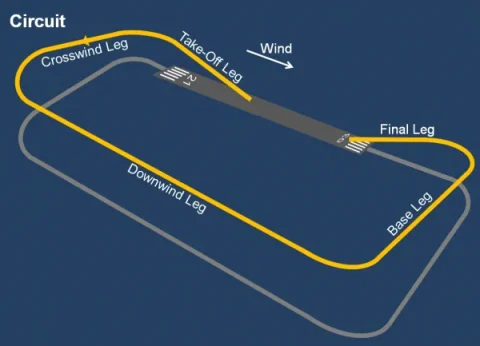
Circuits are when an aircraft departs from the runway and then flies a pattern around the airport to land or to continue flight to complete a series of circuits. At London Biggin Hill Airport (LBHA), the circuit (shown below for illustrative purposes) can be flown either clockwise or counter-clockwise.
Each leg may be extended by Air Traffic Control (ATC) to allow separation between the aircraft flying the circuit and arriving and departing aircraft.
Are there any restrictions to circuit flying?
All aircraft types may undertake circuit flights for the purpose of training, revalidating a pilots licence rating or as part of post maintenance validation. All circuits other than training, and requests for outside of the authorised hours for circuits, require the approval of the Senior Air Traffic Controller (SATCO) or the Chief Executive Officer (CEO).
Circuits are restricted, in accordance with the airport’s Noise Action Plan (NAP), to:
- Monday to Friday: 09.00 to 21.00 hours (Local time)
- Saturday, Sunday & Bank Holidays: 09.00 to 17.00 hours (Local time)
Where can the noise abatement and other information be found for pilots?
Our noise abatement procedures are included in the airport’s Noise Action Plan (NAP) and made available to pilots through the Aeronautical Information Publication (AIP).
The contents of the AIP are managed by London Biggin Hill Airport (LBHA) to ensure that the latest information is always available to pilots that wish to operate in or out of LBHA. Click here to see the latest version.
What aircraft operate from London Biggin Hill Airport?
A vast array of aircraft operate in and out of London Biggin Hill Airport (LBHA); anything from a two seat light aircraft up to an Airbus A320, although the more common larger corporate business jets are the likes of a Bombardier Global or Challenger aircraft.
For jet aircraft to operate at LBHA, they must be “ICAO Chapter 3 compliant or better” – this means that it must meet the noise standards set out in Chapter 3 of part II, Volume 1 of Annex 16 to the convention on International Civil Aviation Organisation. This is fast being superseded by Chapter 4 certified aircraft which was introduced for all new aircraft produced after January 2006.
We restrict the period between 06:30 and 07:00 hours to Chapter 4 certified aircraft as part of our Noise Action Plan (NAP).
Helicopter movements
Operators at London Biggin Hill Airport (LBHA) provide a helicopter shuttle service into London and other destinations. Given the generally lower altitudes and the nature of noise generated from rotors, helicopter operations remain a concern to some residents. Helicopters normally follow light aircraft routes and the associated noise preferential routes. The airport will continue to work together with operators to investigate measures to further reduce noise disturbance wherever possible.
Glossary of Aviation Terms & Abbreviations
The aviation industry uses numerous abbreviations and acronyms. A glossary of this terminology is available on the Civil Aviation Authority (CAA) website here.